Choosing The Perfect Substrate For Your Leopard Gecko

Having a more exotic pet in your home can add some excitement to your life. Unfortunately, because these animals aren't as common in households, there's usually less information about how to look after them. Luckily, if you're struggling to find what you need to look after a leopard gecko, we can help.
One of the most confusing parts of setting up a cage for these creatures is choosing the right substrate. It can be hard knowing which ones are safest to use and what's best, depending on the size and age of your reptile. So, if you need some help choosing the perfect substrate for your leopard gecko, you might be in luck.
Paper towels are absorbent, hygienic, and easily accessible
One of the best substrates to go for with leopard geckos is paper towels. While these might not look as nice, they're highly affordable and readily available. They're particularly good for leopard geckos under a year old, so if you're new to owning one of these creatures, this might be the smartest option. Of course, there's no reason you can't also use paper towels as a substrate for leopard geckos of any age, as this stuff is absorbent, easy to clean, and there's no risk of inhalation. The only real downsides are that this stuff isn't natural to leopard gecko habitats, and it doesn't allow for burrowing. However, this may not be an issue for your pet.
Paper is easy to replace and can be shredded for burrowing
Another of the best substrates for your leopard gecko is paper, with brown butcher paper an ideal choice to go for. Using paper typically makes it quite easy to clean your pet's cage, as you simply need to replace it once it's soiled. Thankfully, as paper is so easy to get hold of, needing to swap it out regularly shouldn't be that much of an issue. With paper, you also have the option of shredding it so that your leopard gecko has something to burrow in. Although there's a chance the reptile could ingest this paper, this rarely happens. Plus, the paper should soften up enough that it won't cause any internal issues for your pet.

Reptile carpet can be swapped out but it may be a little rough
Reptile carpet could also be the perfect substrate for your leopard gecko. Again, cleaning isn't too much of an issue with this stuff; you just need to make sure you have two pieces available. Once one is soiled, remove that and clean it thoroughly, making sure to put the other carpet in its place. Then, once that one needs cleaning, you can simply swap the two and keep doing things in this cycle. Just be aware that some carpets can aggravate your pet's skin, so keep an eye on their belly to ensure it's not irritated. Also, make sure your carpets don't have loose threads, as these could be ingested, or your gecko could get a leg trapped in there.
Sand is easy to scoop out but poses a risk of ingestion
Perhaps the most controversial substrate for leopard geckos is sand. Some people state that you should avoid it at all costs because of the risk of ingestion and impaction. This is usually a bigger problem for younger leopard geckos, so you should definitely avoid it if your pet is still juvenile. Other concerns people have with sand are that bacterial growth isn't unheard of and there can be a risk of respiratory problems. On the flipside, sand is easy to scoop out, making waste removal simple. Plus, it looks a lot more natural than some of these other substrates. Just make sure that if you do use it, you go for fine-grained sand and only have it as a substrate for healthy adult leopard geckos.
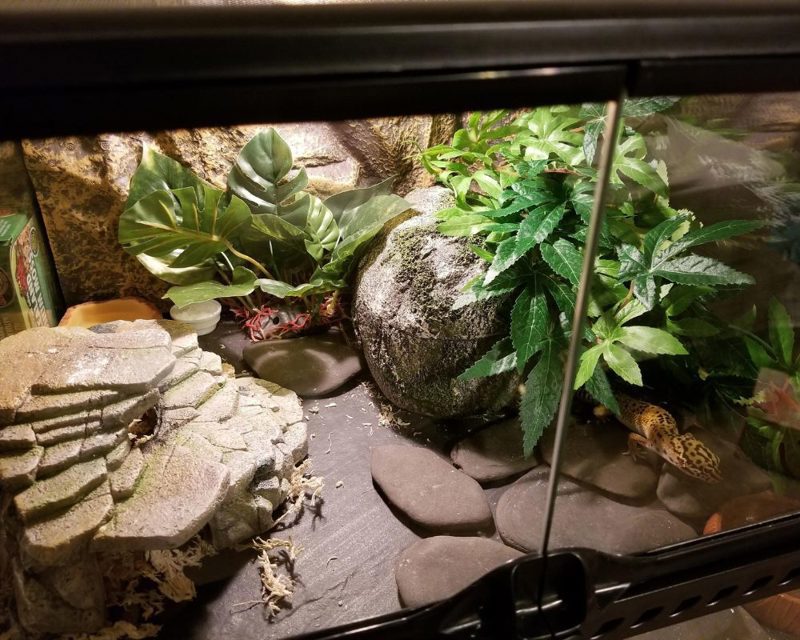
Slate rocks might make sand a safer option for a substrate
If you want to use sand but are worried about the health risks, it might be worth getting some slate rocks for your leopard gecko's substrate. Some people put these in their pet's cage and then use sand to fill the empty space between the rocks. As there's less sand, the risk of ingestion is usually lower, meaning this could be a safer option. Alternatively, you can just fill the whole space with slate rocks. Regardless, the inclusion of these make the environment appear more natural than a lot of these other substrates. These should hold and distribute the heat pretty well too, which is definitely not a bad thing. Just try to make sure that the rocks that you use for your leopard gecko's cage are smooth and flat.
Choosing the perfect substrate for your leopard gecko is important to ensure they stay happy and healthy. There's no definitive answer for what you should choose, as each substrate has its pros and cons. As long as you're avoiding things like wood chips, walnut shells, corn cob, and gravel, you should be good - and your leopard gecko should be happy.
You May Also Like
 Entertainment
The Ultimate Test of Your 2000s Pop Culture Memory
 Entertainment
Which Cozy Weekend Plan Matches Your Personality?
 Entertainment
Can You Identify These Movies From One Object?