Historical Coincidences Too Strange to Invent
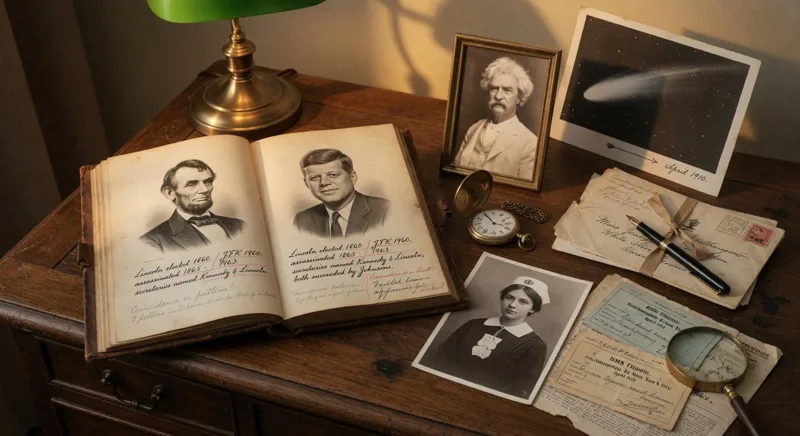
Some historical coincidences are so precise they sound like fiction. From presidents with surprisingly similar biographies to a writer whose life seemed to follow Halley’s Comet, these true stories reveal how chance, timing, and selective memory can create unforgettable patterns.
Why Historical Coincidences Feel So Extraordinary
History contains millions of people, decisions, and events. With so many possibilities, unusual connections are bound to appear. What makes them memorable is the way several details line up: names, dates, locations, family relationships, or repeated disasters.
Still, not every popular coincidence is completely accurate. Some stories combine genuine facts with exaggerated details, while others omit differences that weaken the apparent pattern. The most fascinating examples are those that remain striking even after the myths are removed.
Lincoln and Kennedy: A Famous Presidential Coincidence
The supposed Lincoln–Kennedy coincidences are among the most widely shared facts in American history. Both presidents were elected in years ending in “60”: Abraham Lincoln in 1860 and John F. Kennedy in 1960. Both were assassinated on a Friday, and both were succeeded by men named Johnson.
- Andrew Johnson was born in 1808; Lyndon B. Johnson was born in 1908.
- Both Lincoln and Kennedy had a close aide named John.
- Both presidents were associated with civil rights debates during periods of national conflict.
However, several viral claims are misleading. Lincoln’s secretary was not necessarily named Kennedy, and Kennedy’s secretary was not simply “Lincoln.” Lincoln was shot on Good Friday in 1865 but died the following day, while Kennedy died on the day he was shot in 1963.[2]
The real story is still remarkable: two presidents separated by a century shared several broad biographical and political patterns, even though the popular list has been polished by repetition.
Mark Twain and Halley’s Comet
Samuel Clemens, better known as Mark Twain, was born in 1835, the year Halley’s Comet appeared. The comet returned in 1910, and Twain died on April 21 of that year, just after its perihelion on April 20.[3]
Twain knew about the connection and predicted that he would “go out with” the comet. His statement was not a supernatural prophecy; Halley’s Comet follows a predictable orbit of roughly 75 years. Yet the timing remains an extraordinary example of a person’s life intersecting with a famous celestial event twice.
This coincidence also shows why historical stories become powerful. Twain recognized the pattern himself, gave it literary meaning, and left future generations with a memorable narrative about birth, death, and the return of a comet.[4]
Violet Jessop: The Woman Who Survived Three Ship Disasters
Violet Jessop worked as a stewardess for the White Star Line and was aboard three ships involved in major maritime disasters. In 1911, she was on RMS Olympic when it collided with HMS Hawke. The ship reached port safely, and no lives were lost.[1]
One year later, Jessop served aboard RMS Titanic when it struck an iceberg and sank. She survived after boarding Lifeboat 16. During the First World War, she was also aboard HMHS Britannic when the hospital ship sank in 1916.[1]
Jessop’s story is often described as a case of impossible luck. In reality, her repeated presence had a practical explanation: she worked in the maritime industry and continued accepting assignments at sea. Her career placed her near dangerous events more often than an ordinary passenger would ever be.
Other Historical Coincidences Worth Remembering
The Two Men Who Became Their Own Ancestors
Several old family-history stories describe a person discovering that an ancestor had the same unusual name, occupation, or hometown. While some versions are difficult to verify, genuine genealogical coincidences do occur because names and professions often remain concentrated within families and communities.
The “Same” Photograph Across Generations
Modern archives frequently uncover photographs showing descendants posing in remarkably similar ways to their ancestors. These are not always mysterious: family traditions, inherited clothing, familiar locations, and repeated ceremonies can produce visual patterns across decades. Even so, the resemblance can be startling.
Accidental Connections in Wartime
Wars create enormous movements of people, making unexpected encounters more likely. Soldiers sometimes met childhood neighbors on distant battlefields, while refugees encountered relatives after years of separation. These stories demonstrate that coincidence is often shaped by large historical forces rather than occurring in isolation.
Coincidence or Pattern-Seeking?
Humans are excellent at spotting patterns, but that strength can also mislead us. A list of matching details may seem extraordinary until the unmatched details are included. This is known as selection bias: memorable similarities survive, while ordinary differences disappear from the story.
A useful way to evaluate historical coincidences is to ask:
- Are the dates and names supported by reliable records?
- Are important exceptions being left out?
- Could the people’s jobs or circumstances have increased the odds?
- Does the coincidence remain impressive after separating fact from folklore?
Why These Stories Still Matter
Historical coincidences too strange to invent are more than entertaining trivia. They reveal how people interpret uncertainty, remember dramatic events, and create meaning from random patterns. The strongest stories do not require exaggeration. Lincoln and Kennedy, Mark Twain and Halley’s Comet, and Violet Jessop’s maritime survival all remain fascinating because the verified facts are already unusual enough.
Chance may not write history, but it occasionally produces moments that read like the most carefully planned fiction.
You May Also Like
 Entertainment
The Ultimate Test of Your 2000s Pop Culture Memory
 Entertainment
Which Cozy Weekend Plan Matches Your Personality?
 Entertainment
Can You Identify These Movies From One Object?