Forgotten Inventions That Were Ahead of Their Time
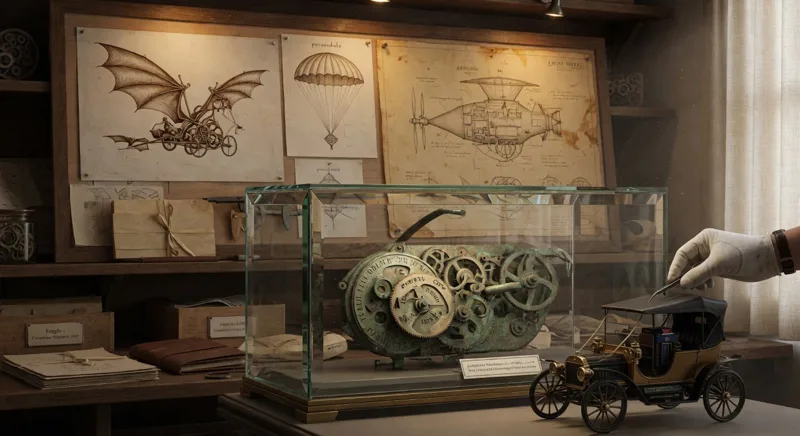
Some of the world’s most fascinating technologies appeared centuries before society had the materials, infrastructure, or imagination to use them widely. These forgotten inventions that were ahead of their time reveal how ancient engineers, scientists, and visionaries anticipated modern machines, renewable energy, aviation, and computing.
Why Were Brilliant Inventions Forgotten?
An invention can disappear for many reasons. A device may be too expensive to build, difficult to explain, dependent on unavailable materials, or created in a society that has no practical need for it. Wars, collapsing civilizations, lost documents, and limited manufacturing can also erase valuable knowledge.
In many cases, the idea itself was sound—but the timing was wrong. Here are several remarkable examples of technology that arrived far earlier than expected.
1. The Antikythera Mechanism: An Ancient Mechanical Computer
Discovered in a shipwreck near the Greek island of Antikythera, the Antikythera Mechanism is often described as the world’s earliest known analog computer. Built more than 2,000 years ago, this compact system of bronze gears could model astronomical cycles, including eclipses and the movements of celestial bodies.
Its design was astonishingly sophisticated for the ancient world. The mechanism used carefully engineered gear ratios to transform the turning of a hand crank into information about the heavens.
Why it was ahead of its time:
- It applied mechanical computing to astronomy.
- It used complex gear trains long before modern clocks.
- It demonstrated precision engineering in an ancient scientific instrument.
The device appears to have been part of a wider tradition of Greek astronomy and mechanical technology, but comparable examples have not survived.
2. Hero’s Aeolipile: Steam Power Before the Industrial Revolution
In the first century, the engineer Hero of Alexandria described a rotating device powered by steam. Known as the aeolipile, it used heated water and angled outlets to create rotational motion.
The machine was not an industrial steam engine. It could not power factories or locomotives, but it clearly demonstrated that steam could produce mechanical movement. More than a millennium later, steam engines would transform transportation, manufacturing, and energy production.
The aeolipile shows that the basic principle of steam power was understood long before practical engineering and industrial manufacturing caught up.
3. Zhang Heng’s Seismoscope: Early Earthquake Detection
In the second century, Chinese scientist Zhang Heng created a device designed to detect distant earthquakes. His seismoscope reportedly used a large vessel decorated with dragons and toads. When an earthquake occurred, a mechanism released a ball in the direction of the disturbance.
Unlike modern seismographs, the instrument did not record the strength or duration of an earthquake. Still, it represented an extraordinary attempt to detect events that could not be felt locally.
Its modern connection: earthquake monitoring now supports building design, emergency planning, tsunami warnings, and geological research. Zhang Heng’s invention was an early step toward that field.
4. Leonardo da Vinci’s Parachute Concept
Leonardo da Vinci sketched a pyramid-shaped parachute in the late fifteenth century. His design proposed a linen canopy supported by a rigid frame, allowing a person to descend safely from a height. There is no evidence that Leonardo built or tested the device himself.[1]
Centuries later, a full-scale reproduction based on his design successfully floated downward during a test, showing that the basic concept could work.[1] Although modern parachutes use different materials and structures, Leonardo’s drawing captured the essential idea of controlled air resistance.
5. Leonardo’s Ornithopter and Flying Machine Designs
Leonardo also studied bird flight and designed machines with wings that moved like those of a bird. His ornithopter concepts were not practical aircraft because human muscles cannot generate enough power for sustained flapping flight.
However, his work anticipated several important areas of aerospace engineering:
- Wing shape and lift
- Air resistance
- Balance and control
- Mechanical transmission systems
His designs were not successful aircraft, but they helped frame flight as a problem that could be analyzed through observation, mechanics, and experimentation.
6. Early Solar Power Machines
Solar energy is often associated with modern photovoltaic panels, but inventors began exploring concentrated sunlight much earlier. In the nineteenth century, engineers developed solar furnaces and solar-powered steam systems that used mirrors to focus heat.
These machines could generate steam for mechanical work, although they were limited by cloudy weather, storage problems, high construction costs, and competition from coal.
Today, concentrated solar power uses mirrors, thermal storage, and turbines on a much larger scale. The underlying idea remains similar: capture sunlight, convert it into heat, and use that heat to produce useful energy.
7. Early Electric Cars
Electric vehicles are frequently treated as a modern invention, but electric cars existed in experimental and commercial forms during the nineteenth century. They were quiet, simple to operate, and free from the smoke associated with early gasoline engines.
Their progress stalled because battery technology was limited, charging infrastructure was almost nonexistent, and gasoline vehicles became cheaper and more convenient for long-distance travel. Electric cars eventually faded from public attention for much of the twentieth century.
The modern return of electric vehicles reflects improvements in lithium-ion batteries, charging networks, software, and manufacturing—not the sudden discovery of the concept itself.
What These Forgotten Inventions Teach Us
These examples offer a useful lesson: technological progress is rarely a straight line. An idea can be scientifically correct and still fail to become widespread.
- Infrastructure matters: inventions need roads, power grids, factories, or communication networks.
- Materials matter: advanced designs often depend on materials that did not yet exist.
- Affordability matters: a working prototype may be too expensive for everyday use.
- Social demand matters: people adopt technology when it solves a pressing problem.
- Knowledge must survive: lost records can delay progress for centuries.
Conclusion: Great Ideas Can Wait for Their Moment
Forgotten inventions that were ahead of their time remind us that innovation is not only about having a brilliant idea. Success also depends on timing, manufacturing, investment, public need, and supporting technology.
From ancient astronomical computers to early steam engines and pioneering electric cars, history is filled with concepts that seemed impossible—or simply arrived too soon. The next breakthrough may already exist in an overlooked laboratory, archive, or workshop, waiting for the world to catch up.
You May Also Like
 Entertainment
The Ultimate Test of Your 2000s Pop Culture Memory
 Entertainment
Which Cozy Weekend Plan Matches Your Personality?
 Entertainment
Can You Identify These Movies From One Object?